
The Golden Egg Initiative: ALL THE RAGE
Opening Today: Why ALL THE RAGE Refuses to Let the Stories of Epstein Survivors Disappear: Ahead of its opening at Theatre Deli, Rebecca Lenkiewicz, Anoushka Warden and Deborah Pearson discuss the collective artistic response challenging silence, power and the systems that enable abuse.
Written by: Katie McElligott Ryan
“Our shared rage is a wonderful rocket fuel.” Rebecca Lenkiewicz
Today, on 11 June, ‘ALL THE RAGE’ opens its doors to audiences at Theatre Deli on Leadenhall Street, with the support of Gold Rush Pictures’ Golden Egg cultural patronage initiative. Far from a conventional play, this ambitious large-scale production - created by more than eighty female-identifying and non-binary writers and artists, directly confronts the enduring presence of the Epstein scandal in the public consciousness while exposing the broader systems of power, exploitation, and complicity that continue to enable similar abuses today. What connected each conversation, I found, was not outrage alone, but a shared determination to resist repetition and erasure.
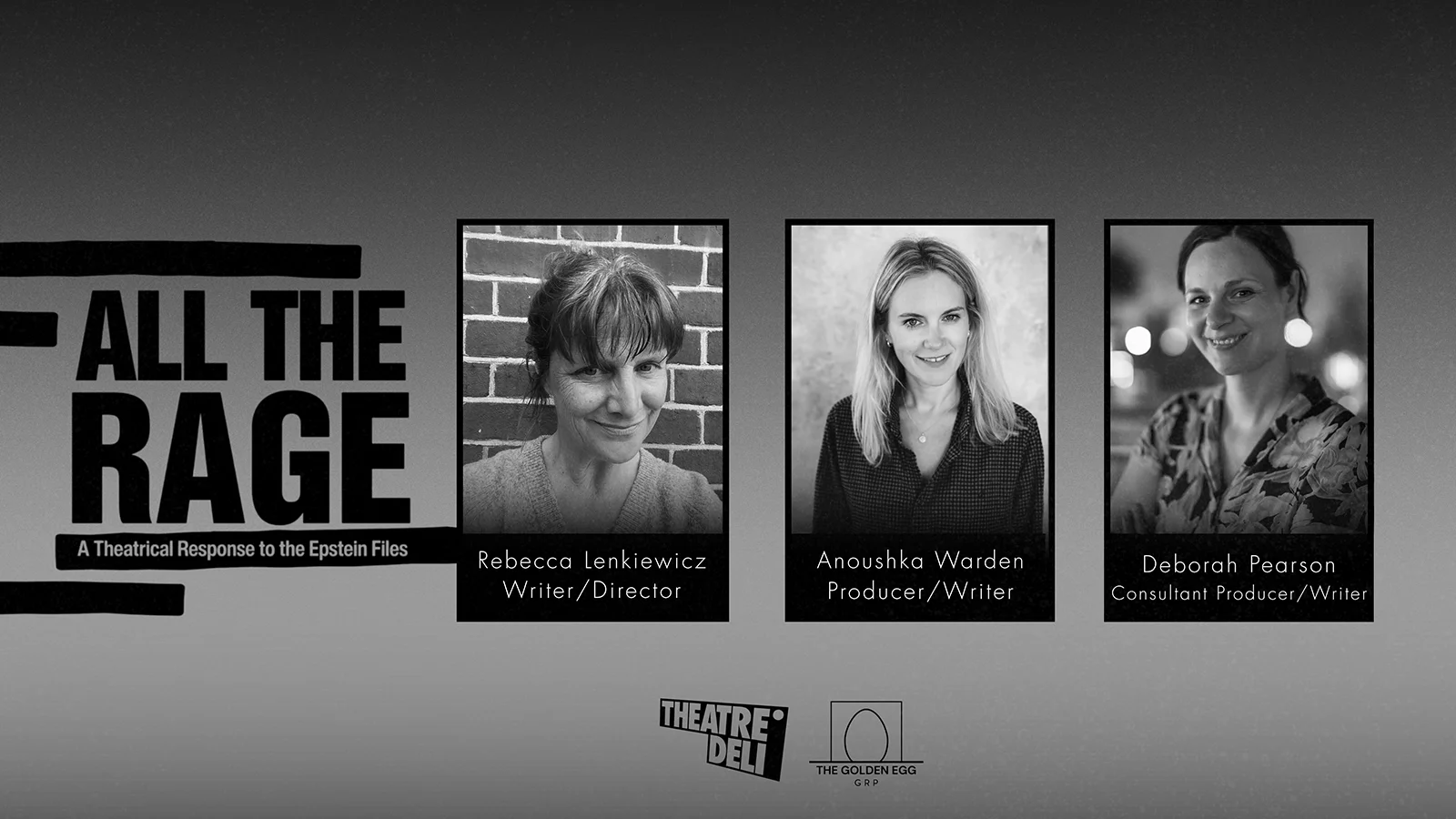
Ahead of the production’s much-anticipated opening night, I spoke with writer-director Rebecca Lenkiewicz- the screenwriter behind She Said , the Oscar-nominated drama chronicling the reporting that exposed Harvey Weinstein, alongside writer-producer Anoushka Warden and consulting producer (and writer) Deborah Pearson, about the origins of this ambitious project and why they believe the conversation it demands remains far from over.
“There are powerful players in the world who are desperate to overwhelm us with information and to let this actually very recent revelation of abuse and corruption fade into the background among all of the other things we are enraged about right now.” Deborah Pearson
There is a recurring sense that the production exists in opposition to the mechanisms that allow public attention to drift elsewhere. While the Epstein files provide the catalyst, the artists involved are less interested in a singular scandal than in the structures that made it possible, highlighting their continued disregard.
This refusal to forget is at the very core of ALL THE RAGE.
Each element of the production feels intentional and acutely metaphoric. Even its setting -a former office floor- reinforces the productions central themes of power, complicity and institutional failure. This location also allows the production to one floor, across fifteen spaces and unfold installations, performances, poetry and theatrical interventions before culminating in a collective theatrical act that brings its many voices together.
“Through the windows you can see both old churches and parts of the Gherkin and the Lloyds building where fortunes are made or lost. Being at the epicentre of the financial district feels significant and ironic.” Rebecca Lenkiewicz
Significantly, the production sits within sight of the financial institutions that have come to symbolise power and influence in modern Britain. The allegories are difficult to ignore. The office floor, once a site of transactions, capital and corporate power, has been transformed into a temporary habitat for artists and an audience alike. By utilising this space, the production invited visitors to confront the industries and systems that once dominated it. “We are peopling it and filling it with sound and energy,” Lenkiewicz continues: “It is a protest against the corruption involved in Epstein's wealth.”
“Creating a space where women's rage could exist without being softened, justified or apologised - was crucial.”Anoushka Warden
In this repurposed financial enclosure, Warden suggests that ALL THE RAGE offers a rare opportunity for writer’s voices to symbolically and physically reclaim a space historically complicit in in structures of power, wealth and exclusion. Pearson states, “Many of the works interrogate both the shocking specificity of the abuse chronicled in the Epstein files as well as the ubiquity of patriarchal structures that are damaging to all genders.” Lenkiewicz echoes this sentiment: “This cycle of violence against women just repeats and repeats in a world where money buys silence and corruption is hidden.” What emerges is not a theatrical retelling but an examination of this crisis: the conditions under which exploitation flourishes and the cultural habits that permit it to endure.
“The galvanising idea of a collective is an ancient one.” Rebecca Lenkiewicz
Fittingly, the project itself emerged through collective action. What began as a WhatsApp conversation rapidly expanded into a collaboration involving more than eighty determined artists spanning generations and disciplines. Following the release of the files, she asked fellow writers whether they shared her frustration at what she perceived as an inadequate response. Lenkiewicz states, “There was a large group of female-identifying and non-binary writers who responded with a loud yes.”
Significantly, this conversation was never intended to centre around the powerful men whose names already dominate public discourse. “We wanted to create a voice from the survivors’ point of view, not focusing on the men and the money.” In an era marked by the marginalisation of survivors, the persistence of victim-blaming and contested ideas of authorship. There is something undeniably radical about the sheer scale and shared urgency of this collaboration. Writers in their twenties work alongside writers in their eighties, with ideas flowing fluidly between generations. Responsibility, too, is shared. “It has been something of a relay,” Lenkiewicz reflects. “Various people passing the baton and taking the weight then sharing it again.”
For Warden, creating that environment was essential: “The title certainly speaks to anger as both an emotion and a political force, though for us it carries a slightly broader set of meanings than that alone.”
Rage itself only tells part of the story.
Throughout our conversations, all three women repeatedly returned to the emotional complexity of the work. Outrage may have been the initial prompt, but not its defining force. When confronting a problem of this scale and history, its complexity expands into multiple, shifting dimensions- an attempt to define a megagon.
“Rage may have been the spark that brought us together," Warden explains, “but the work itself is far more expansive than that. Across the project there is grief, tenderness, humour, vulnerability, defiance, compassion and even joy.” That breadth feels important. It transforms the production from an expression of outrage into something more sustained: a meditation on resilience, solidarity and survival.
What lingers after speaking with the team behind ALL THE RAGE is a strong sense of empathy and allegiance. The production is a call to action, demonstrating what happens when people refuse honesty, refuse to forget and refuse to allow difficult conversations to dissolve into the background into the noise of modern life. “I hope audiences connect to the sheer scale of the rage and resilience that we are holding here.” says Pearson.
What is perhaps most striking about ALL THE RAGE is its demonstration of how writers can transform testimony, anger and collective memory into something active rather than archival. Throughout her career, Lenkiewicz’s writing has repeatedly interrogated systems of power and the silencing of women, and that concern runs through the veins of this triumphant production. Here, however, authorship itself becomes part of the statement.
More than eighty contribute their voices, creating a work that resists both singular ownership and easy dismissal. As Pearson puts it: “Any time we gather to resist there is radical potential there.” In a cultural landscape increasingly defined by fragmentation, distraction and disregard, this collective act offers a rare sense of community and hope.
Demonstrating rage as an impetus force.
Full list of ALL THE RAGE collaborators:
Alison Jean Baker, Amy Powell Yeates, Andrea Lowe, Anna Jordan, Anoushka Warden, Aoife Lennon, Beattie Green, Bex Bowsher, Chantelle Dusette, Chloe Palmer, Clare Barstow, Cordelia Lynn, Deborah Pearson, Eleanor Hope-Jones, Ellen Bannerman, Emily White, Emma Adams, Emteaz Hussain, Genevieve Dawson, Georgia Fitch, Grace Chapple, Gurpreet Kaur Bhatti, Gwawr Loader, Hannah Mulder, Jane Upton, Jasmine Naziha Jones, Jaz, Jemma Kennedy, Jennifer Lunn, Jenifer Toksvig, Jessica Siân, Jill O'Halloran, Judith Johnson, Julia Grogan, Julie Tsang, Karen Cogan, Karis Kelly, Katharine Fry, Katie Elin-Salt, Kayla Feldman, Kelly Jones, Kerry Fitzgerald, Laura Horton, Laura Lomas, Laurie Ogden, Leyla Nazli, Lisa Parry, Lucinda Coxon, Lucy Edkins, Lucy Kirkwood, Manjinder Virk, Maria Messias Mendes, Maud Dromgoole, Melissa Dunne, Molly Davies, Naomi Sheldon, Naomi Westerman, Noga Flaishon, Oriana White, Penelope Skinner, Phoebe Eclair-Powell, Poppy Corbett, Rachel Mars, Rachel McKay, Rachel Tookey, Rafaella Marcus, Rebecca Brewer, Rebecca Crookshank, Rebecca Jade Hammond, Rebecca Lenkiewicz, Rebecca Manley, Ruth D'Silva, Sadie Pearson, Sarah Hehir, Sarah Sigal, Sasha Frost, Selina Thompson, Suhayla El-Bushra, Temi Wilkey, Timberlake Wertenbaker, Victoria Richards and Zinnie Harris.
%20Lead%20Images06%20(1).webp)
